Between Arrival and Departure: How Space Shapes the Waiting Mind
Mapping how 73+ participants navigate a space designed for arrival, not orientation.
"Waiting in the Great Hall is like watching Chicago weather unfold; you're constantly scanning for the next change."
Chicago Union Station Great Hall · 100+ years old · $54M renovation · 130,000 daily commuters.
In collaboration with Jiawei Zhang.
The Challenge
There is no clear "start here" moment on entry. Travelers enter through multiple entrances, falling back on screens, staff, crowd-watching, and gut instinct to find their bearings.
Improve the spatial and information system so travelers can wait, orient, and navigate with greater comfort, confidence, and clarity.
The Research
A seven-week multi-method field study, October to December 2025, structured across three sequential methods: contextual observation, intercept interviews, and activity-based reflection sessions.
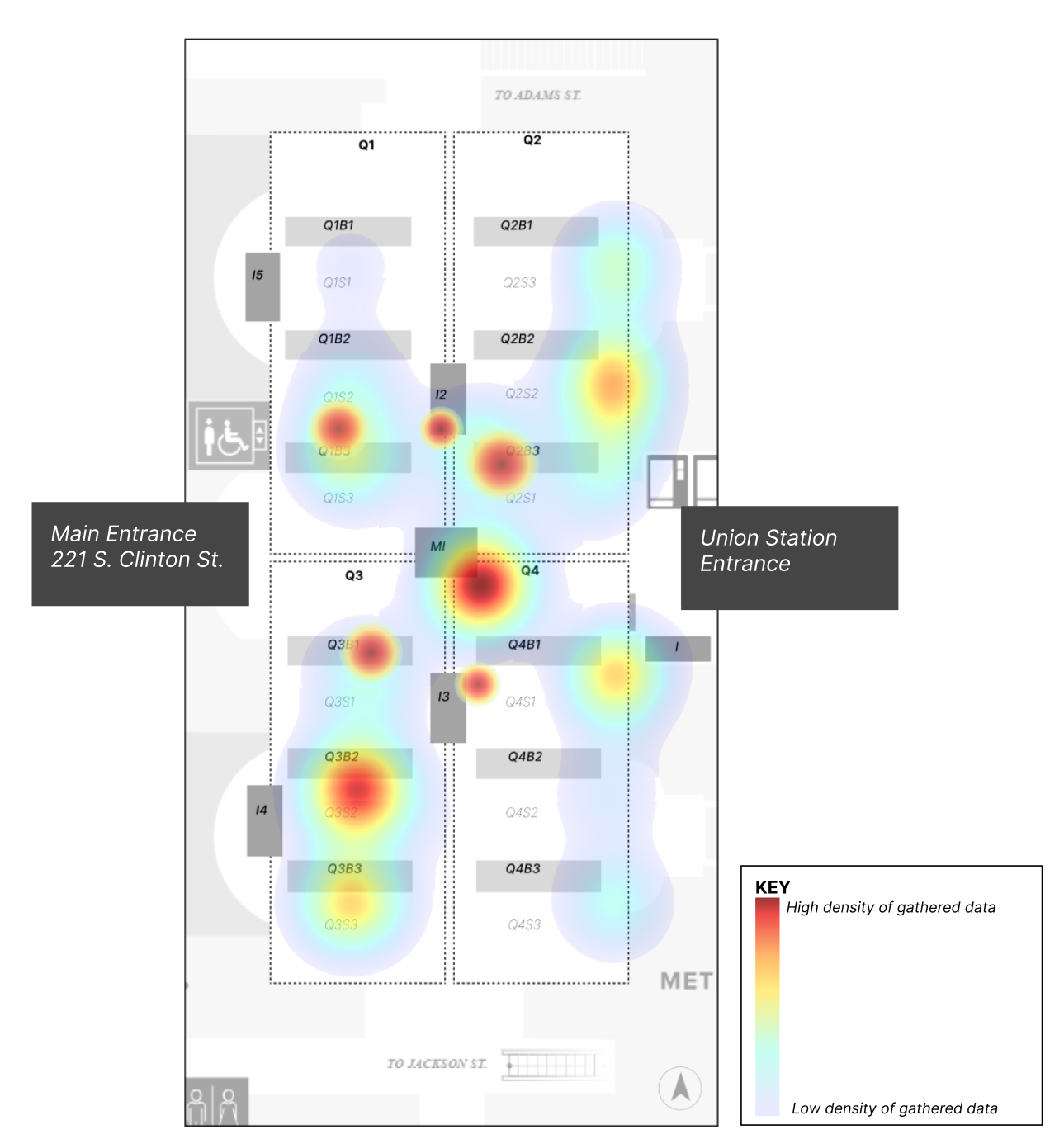
Heat Map · Observed participant density across the Great Hall · 4 observation sessions.
Contextual Observation
Based on the POEMS framework, we developed our own observational framework tracking four dimensions across every session: User Behavior / Activity, Environmental Factors, Informational Factors, Expression / Gesture. Fully non-participatory, establishing baseline behavior across the hall before talking to anyone.
Intercept Interviews
Five intercepts, 15 to 20 minutes each, with travelers waiting 30 to 45 minutes before departure. A deliberate mix of solo travelers, families, first-timers, and regulars.
Activity-Based Interviews
Two reflective sessions with printed floor plans, photo cards, and prototype sketches, surfacing how travelers reasoned about the space when given tools to point at it.
What We Found
Four behavior types emerged, mapped across stress level and navigation frequency. Underneath them, four spatial insights about how the hall actually performs as a wayfinding environment.
The Confirmation Looper
Most common. Manages anxiety by repeatedly re-checking screens, tickets, and asking staff.
The Urgent Navigator
Moves fast, needs reliable cues, high pressure.
The Guided Wanderer
Follows the environment or other travelers passively.
The Confident Regular
Navigates effortlessly through habit and familiarity.
Participants across all research methods
Research methods: Observation, Intercept, Activity-Based
Observed behavior categories logged
"Check the information board" was the most repeated behavior, logged 15 instances over observation sessions.
- 01
There is no clear start. Entrance areas create a pause of uncertainty.
- 02
Multiple boards create information fragmentation. Travelers gravitate to the main board even when a smaller one carrying the same information sits closer to them.
- 03
Information zones trigger anxiety and rushed decisions rather than calm orientation.
- 04
Seating areas serve as spaces of partial alertness, not full rest. Information monitoring continues in repeated check-in loops, from board to phone to board, even while seated.
The Response
Two design directions, both targeting the gap between the hall's grandeur and its legibility. One operates on the ground plane, the other on the rhythm of how information reaches travelers.
Floor Navigation Paths
Color-coded pathways embedded in the floor: Blue → Information, screens, and staff; Red → Boarding gates; Green → Amenities. Preserves the historic architecture while solving wayfinding at ground level, where travelers are already looking.
Passive Information Delivery
Reduce check loops by fitting information naturally into what travelers are already doing, lowering the mental load of repeated active checking and freeing the seated wait from constant re-verification.
Outcome
The Great Hall was designed for grandeur, not orientation. Without clear structure, travelers defaulted to anxious self-management: loops, double-checks, crowd-watching, staff questioning. The research delivered a grounded behavioral framework and two specific design directions to Amtrak.
"In a space used by 130,000 people daily, the gap between beautiful and functional is felt most acutely by the people who've never been there before."