← Back
Project 02

The Next Era of Customer Relationship Building.

Graduate Service Design Consultant·IIT Institute of Design·Fall 2025
14

Weeks from first interview to final blueprint

6

Phases mapped across the full customer lifecycle

16

Swim lanes spanning goals, capabilities, software, operations, and customer action

A business powered by memory, spreadsheets, and instinct. Over 14 weeks, we designed a centralized system that made information faster to access, easier to manage, and more actionable across the organization.

Through stakeholder interviews, cross-functional workshops, and service mapping across sales and operations, we developed a six-phase CRM integration strategy for a regional B2B industrial supplier operating in a relationship-driven industry where much of the operational knowledge remained undocumented.

In collaboration with Arundhuti Bhattacharya and Shimama Zainab.

01: RESTRUCTURING A LEGACY B2B INDUSTRIAL SUPPLIER

Transforming decades of unwritten expertise into a structured business engine.

To map the company's fragmented operations, turning isolated personal expertise and manual tracking practices into a shared digital framework. The objective was to design a comprehensive 16-lane service blueprint and CRM integration strategy (Assist) that eliminates process bottlenecks, reduces staff administrative overhead, and builds repeatable customer loyalty.

Context · Themes and Insights

Theme 1: Knowledge Sharing

From: FROM: INDIVIDUAL MEMORY
To: TO: COMPANY SECOND BRAIN

Critical operational and customer details only lived in employees' heads. Because this knowledge wasn't written down, it was hard to share, slowed down new staff training, and meant team members had to solve the same customer problems over and over.

Theme 2: Data Management

From: FROM: SCATTERED SPREADSHEETS
To: TO: CENTRALIZED CUSTOMER HUB

Customer interactions and sales leads were tracked across outdated spreadsheets and paper notes. This manual setup made it impossible to see the sales pipeline in real-time, leaving the team reacting to issues instead of spotting opportunities.

Design Opportunities
HMW 01: THE CONSULTATIVE FLOOR

How might we give floor staff instant access to customer history so they can offer personalized, expert service on the spot?

HMW 02: THE CONNECTED JOURNEY

How might we tie outreach, in-store visits, and customer accounts into a single, seamless flow?

HMW 03: THE SHARED BRAIN

How might we capture individual staff expertise so that any team member can deliver the same high level of service?
The Future State Story
01
02
03
04
05
06
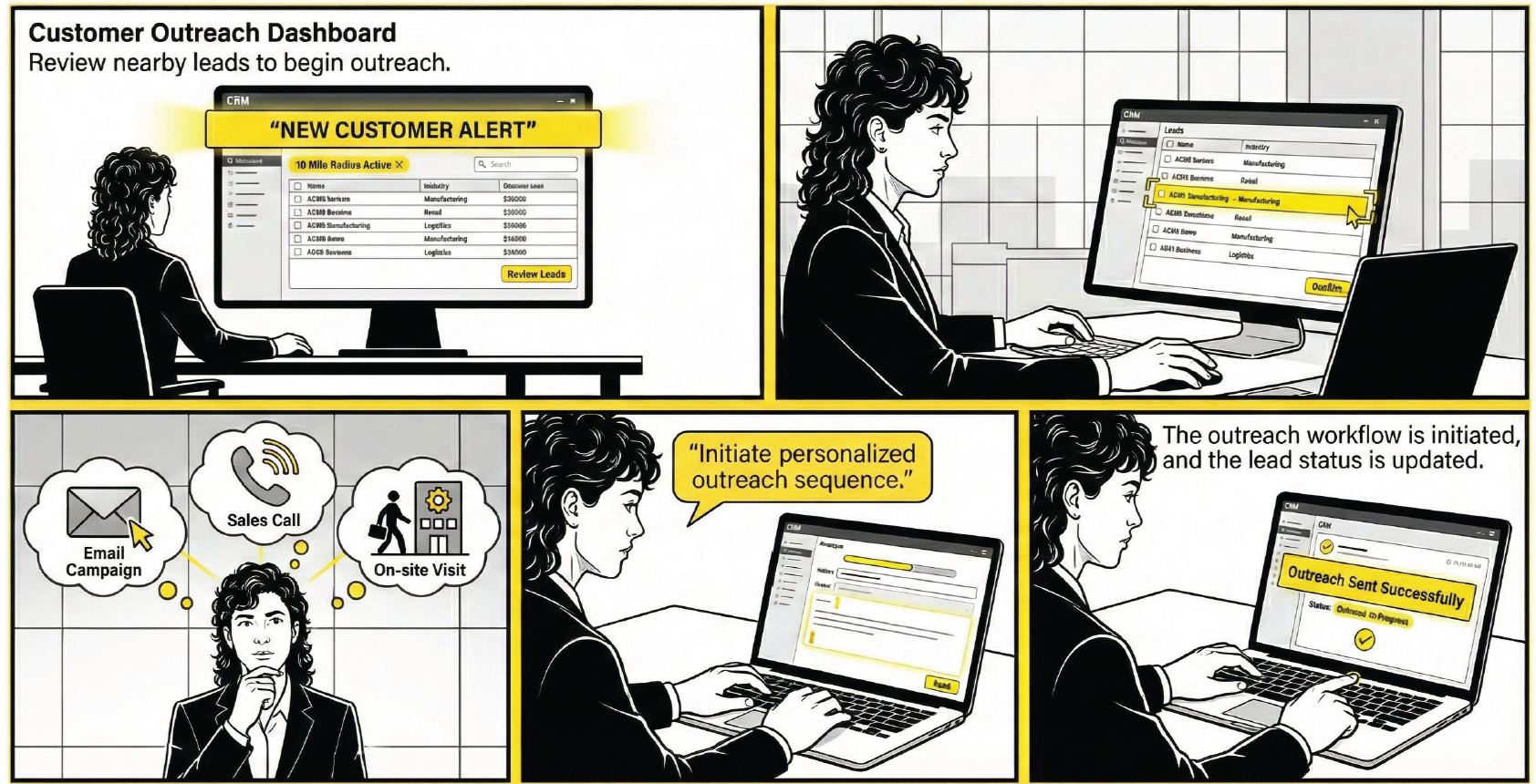
01 Getting Started / First Spark
01 · Getting Started / First Spark
Lead identification → Prioritization
Identify → Tag → Reach out

CRM identifies and tags a manufacturer as a promising potential customer. Outreach initiated with email, sales call, and on-site visit options.
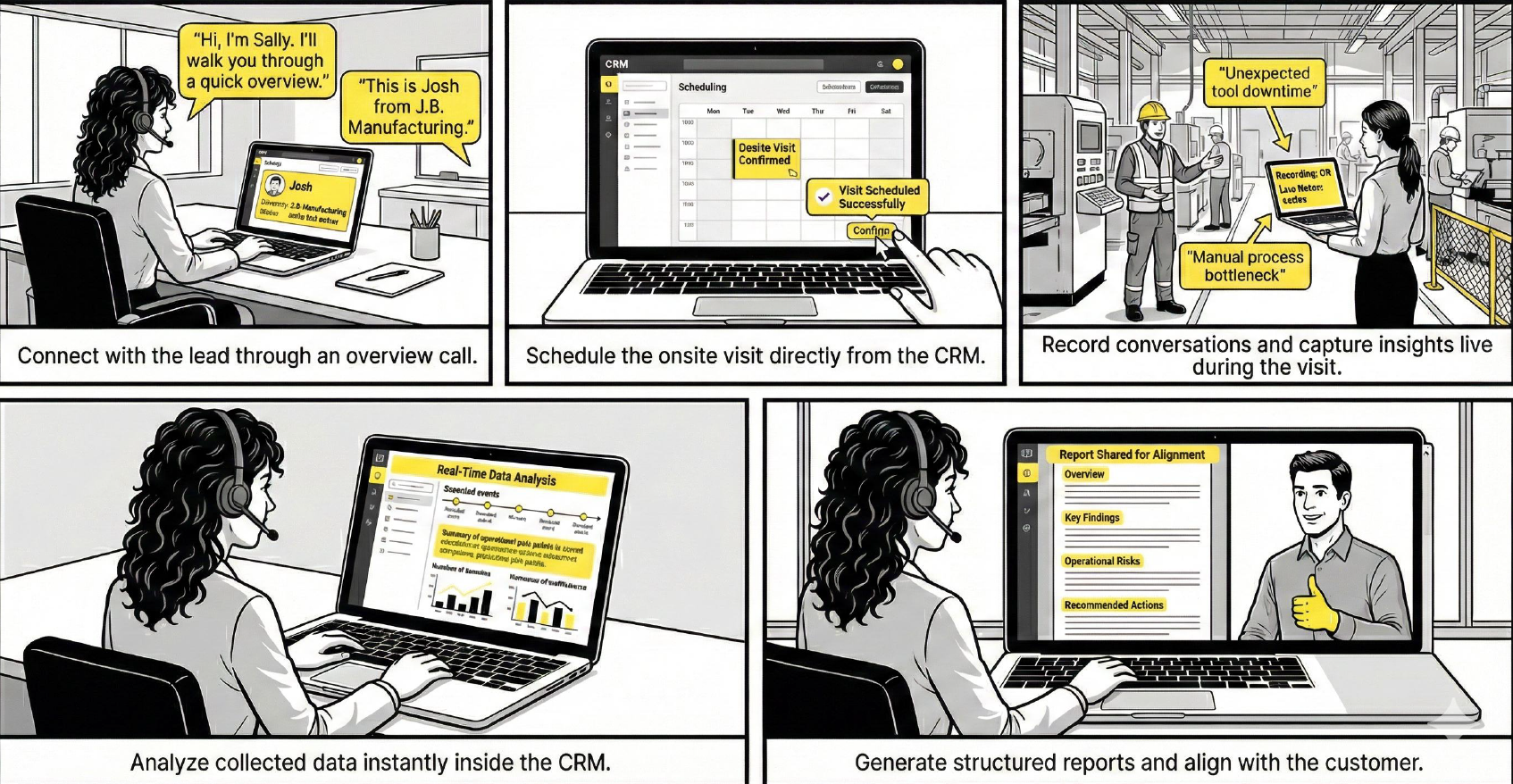
02 Discovery and Understand
02 · Discovery and Understand
Discovery → Assessment → Qualification
Contact → Overview call → Site visit

Contact initiated through CRM with a customized automated email. After an overview call, a site visit is scheduled. CRM voice note-taking feature documents and simultaneously analyzes the conversation.
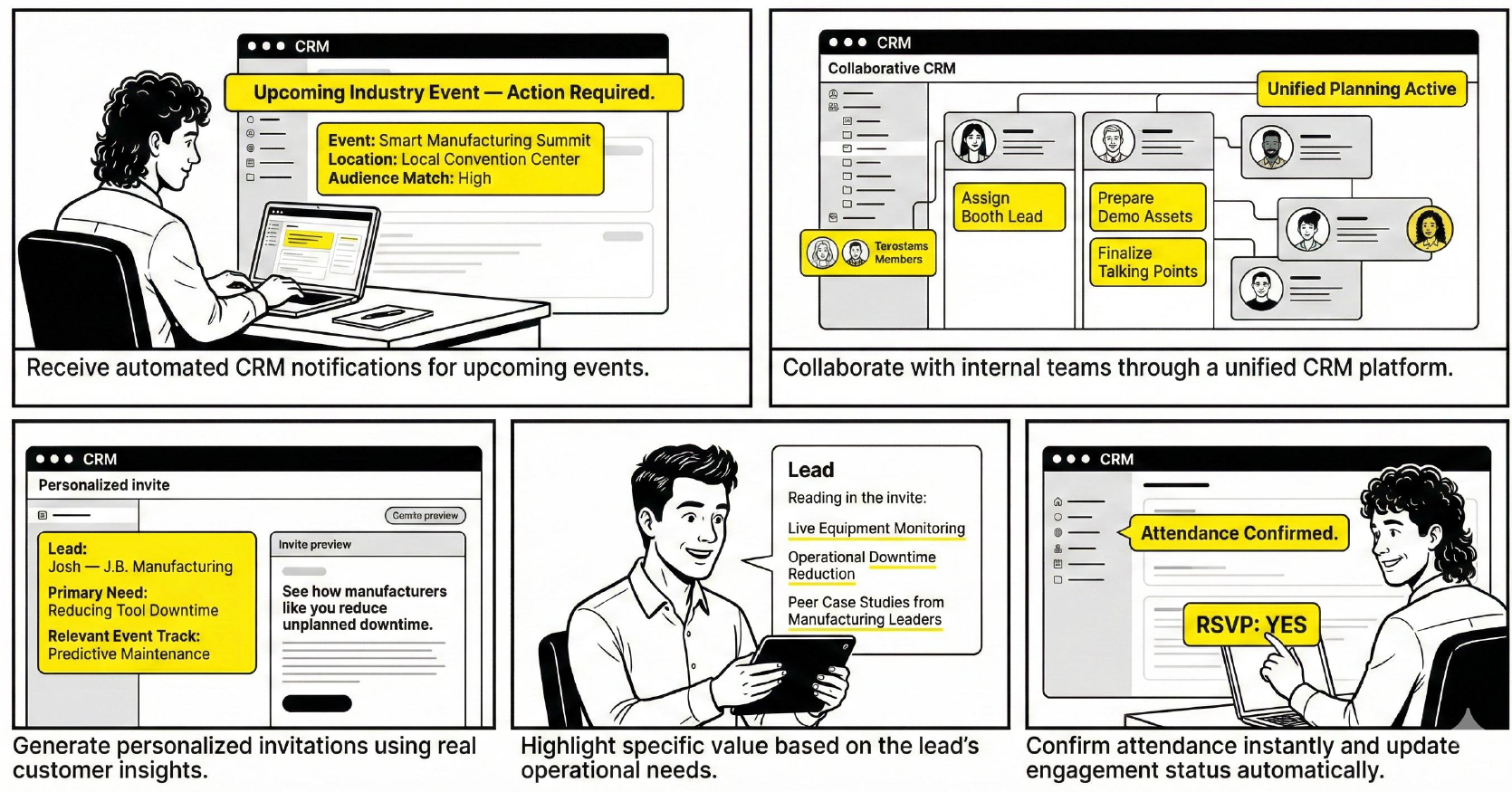
03 Discovery and Customized Prep / The Personal Invitation
03 · Discovery and Customized Prep / The Personal Invitation
Pre-event engagement → Enticement → Confirmation
Tailor → Invite → Confirm

Personalized invitations tailored to the lead's specific needs sent using CRM data. Attendance confirmed and engagement status updated automatically.
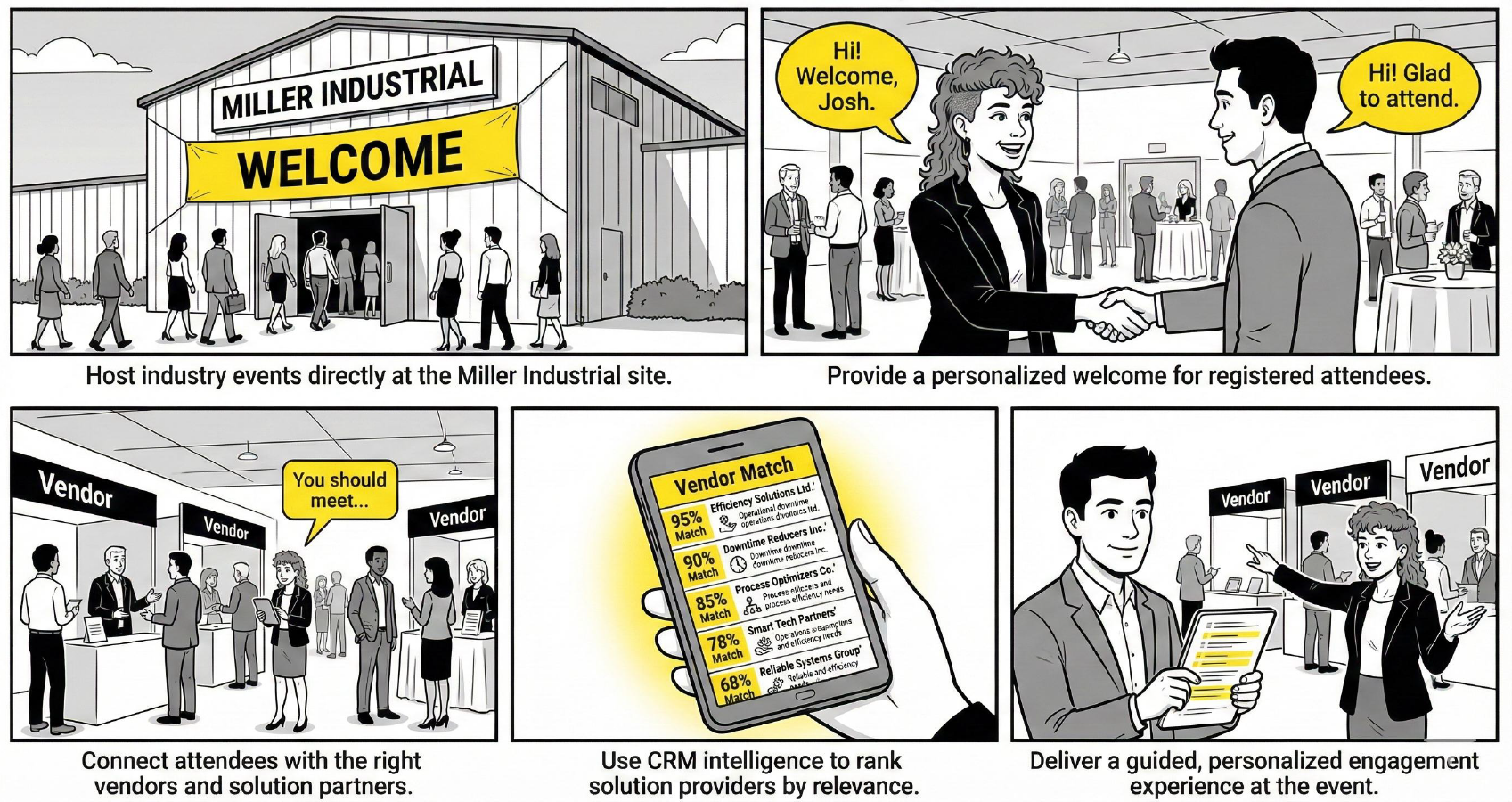
04 Engage and Guide / The Event
04 · Engage and Guide / The Event
First impression → Trust building → Budding relationship
Welcome → Rank vendors → Guide

First time a potential customer steps into the client's world. CRM intelligence ranks vendors by relevance and delivers a guided, personalized engagement experience.
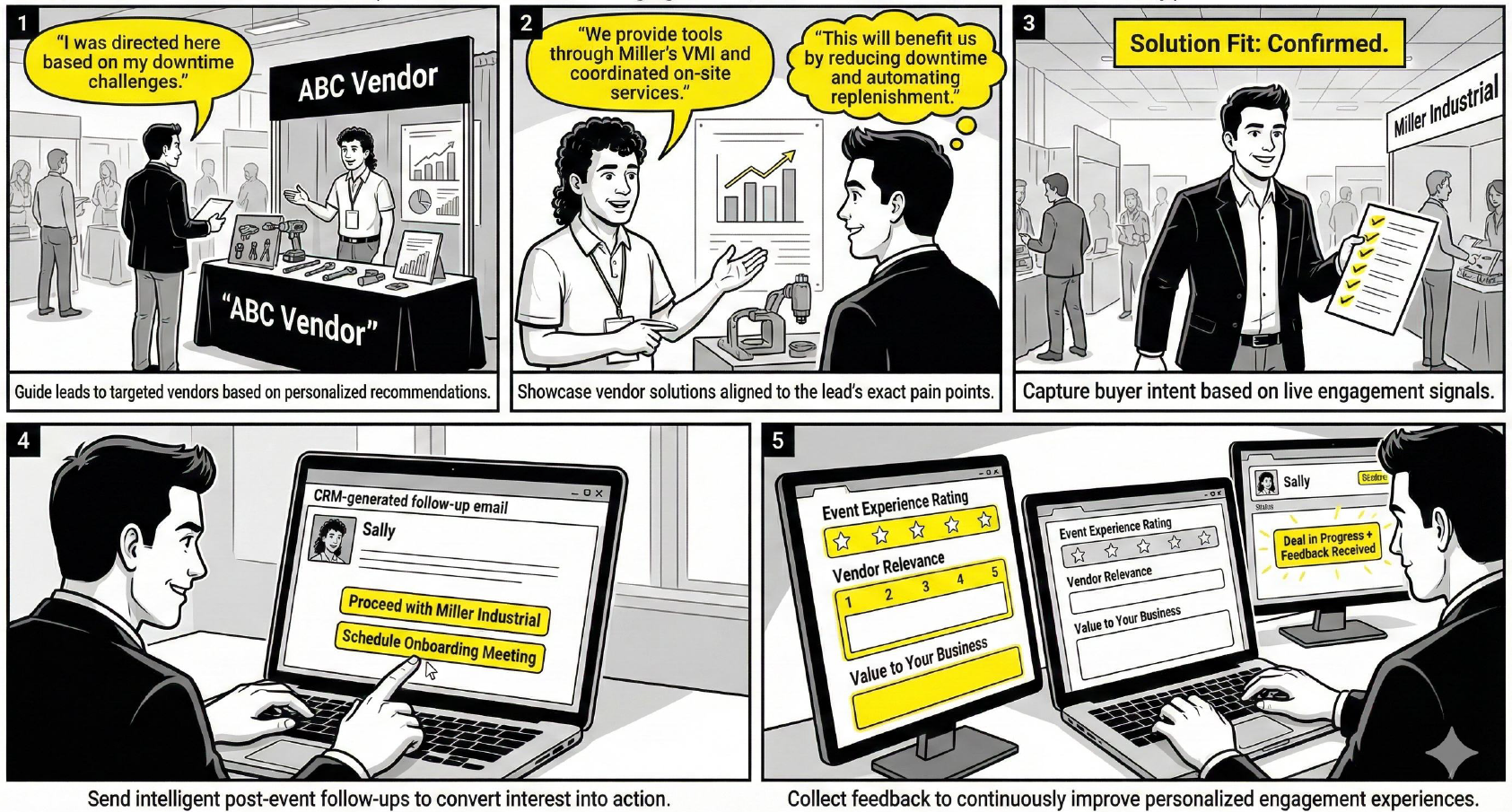
05 Engage and Guide / Walkthrough and Interaction
05 · Engage and Guide / Walkthrough and Interaction
Experience → Value demonstration
Match → Demonstrate → Follow up

CRM determines customer-provider fit, matching best-fit vendors. Post-event follow-ups and feedback collection automated.
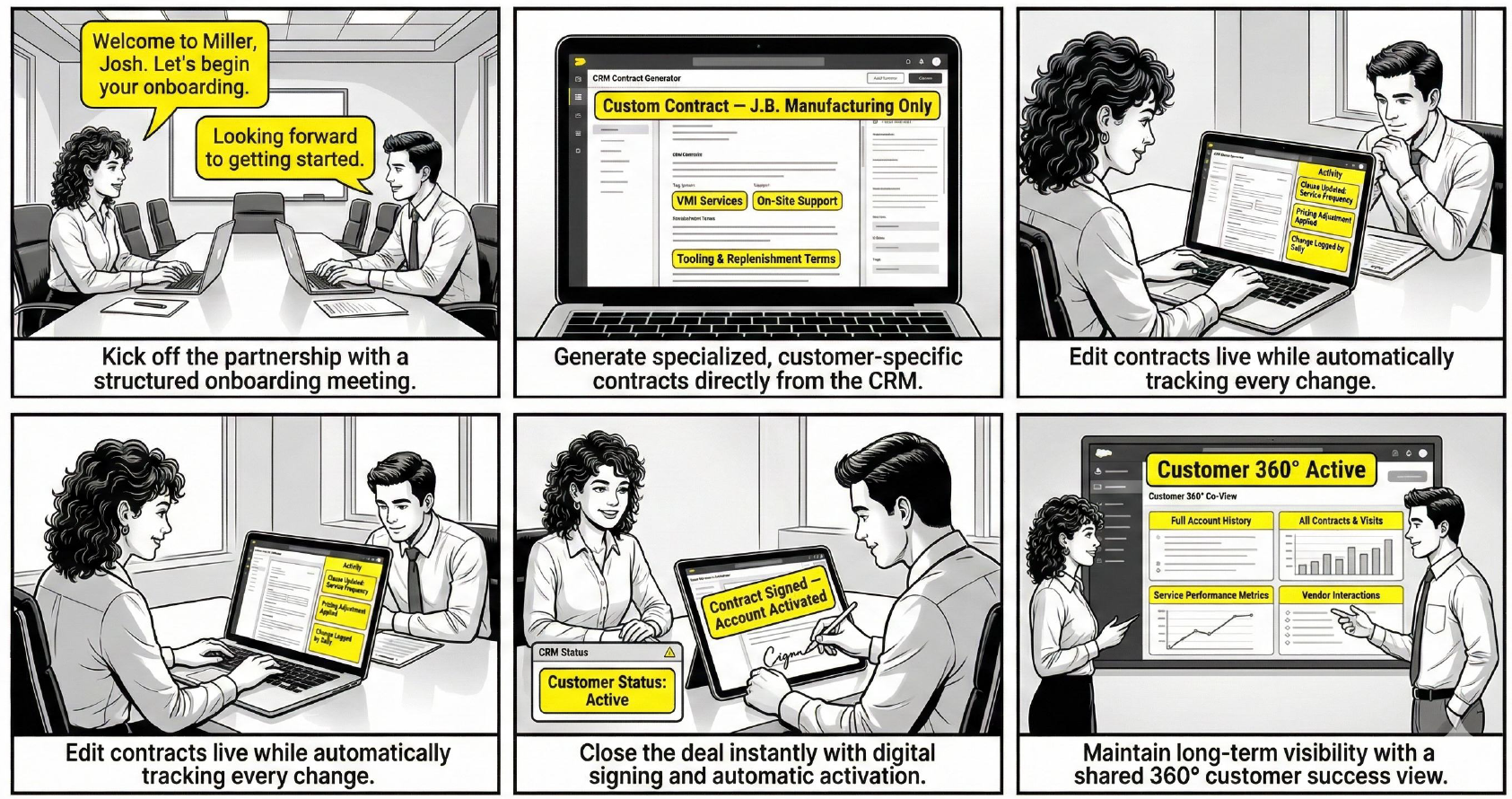
06 Onboarding and New Beginnings / The Conversion Moment
06 · Onboarding and New Beginnings / The Conversion Moment
Decision → Agreement → Account onboarding
Convert → Contract → Co-view

Lead converts to account customer. Customized contracts generated from CRM. Customer 360° co-view keeps both parties aligned.

Continue scrolling
The Blueprint

A unified service blueprint for Assist.

Goal: Provide an ideal state of incorporating a CRM software called Assist to optimize the Director of Customer experience and outcomes.

The blueprint maps how Assist integrates across the client's existing service system. Connecting outreach, coordination, and customer data into one coherent operational flow.

SERVICE BLUEPRINT · ASSIST CRM INTEGRATION
Download Full Blueprint ↓
The Prototypes
Feature 01

Market Opportunity Scanner

Getting the right prospects into the client's landscape.

  • Segment by location and quantify prospects by industry and engagement.
  • Assess a prospect's buying capacity.
  • Visibility into nearby high-potential businesses.
  • Unverified assumptions about industry trends or customer intent.
Feature 02

Customer Segmentation

Understanding customer operations so the client has clarity when serving potential customers.

  • Quickly generate customer and industry overview reports.
  • Clarity on market opportunities for each lead or segment.
  • Detection of recurring patterns across similar customers.
  • Overlooking urgent or high-risk customer needs staff can't easily classify.
Feature 03

Collaboration Hub

Centralizes conversations, notes, and tasks so the whole team stays aligned.

  • Shared visibility into customer and lead interaction.
  • Capture of qualitative context from frontline conversations.
  • Alignment across teams on who owns the next step.
  • Miscommunication or duplicated outreach.
Feature 04

Customer 360° Profile

Guiding customers from interest to action and strengthening the relationship.

  • Better qualification and prioritization using buying capacity, value tier, and engagement score.
  • Stronger account planning with clear history across touchpoints.
  • Upsell and retention opportunities surfaced through pattern recognition.
  • Time wasted searching across spreadsheets, email threads, and PDFs.
Feature 05

Customer Activation Hub

Guiding customers from interest to action.

  • Faster qualification via automated scoring and tags.
  • Marketing insight into which channels drive best leads.
  • Cognitive load to manually remember history, readiness, and alignment.
Feature 06

Survey Integration

Onboarding customers.

  • Centralized insights from multiple survey tools including Qualtrics and Typeform.
  • Early detection of customer pain points and service gaps.
  • Data-backed decisions on product, service, and process improvements.
  • Manual feedback collection and scattered survey reports.
Feature 07

Dashboard

Helping teams start the day with clarity on priorities, workload, and pipeline movement.

  • Instant visibility into lead sources and pipeline movement.
  • Manager visibility into workload and bottlenecks.
  • Manual tracking of follow-ups and lead movement.
Research Process

Stakeholder Interviews & Cross-Functional Workshops.

To ground the CRM concept in real workflow, we conducted two stakeholder interviews and facilitated two cross-functional journey mapping workshops with the client's sales and service staff. Sessions were run remotely using Miro, focusing on how staff currently manage customer relationships across outreach, coordination, and follow-through.

Staff Journey Mapping Workshop · Session 1

Participants
Sales lead and head of operations
Format
Online Miro workshop
Focus
Mapped day-to-day coordination and customer interactions shaping the client's overall service experience.
  • Entice

    How the client reaches out and connects with new or existing customers and suppliers.

  • Engage

    How the client interacts with customers every day.

  • Extend

    How information and insights are shared across the team.

Staff Journey Mapping Workshop · Session 2

Participants
Managing/Leadership Partner
Format
Online Miro workshop
Focus
Understanding how leadership sees each phase from a broader business and investment perspective, focusing on key drivers that influence decision-making and long-term growth. Prototypes were introduced and evaluated against each phase of the journey map.
entice
  • Stronger customer and supplier relationships
  • Actionable data from event interactions
  • Manual work from Word and spreadsheet tracking
engage
  • Knowledge consistency between frontline and floor operations
  • Streamlined information for consultative quick service
  • Reduce duplicate communication
extend
  • Real-time visibility of customer needs
  • Communication effectiveness between floor staff and Sally
  • Reduce duplicated communication
Stakeholder Interviews

Two separate interview sessions were conducted throughout the process to understand individual staff workflows, pain points, and priorities. Interviews informed both the journey map structure and the direction of the CRM prototype features.

  • Interview 01

    Sales & Customer Outreach workflow, focused on lead management, event follow-up, and customer data practices.

  • Interview 02

    Service & Operations workflow, focused on day-to-day coordination, order management, and cross-team communication.

"These sessions revealed that the gap wasn't just in tools, it was in how knowledge moved, or didn't, between the people closest to the customer."

"When knowledge moves cleanly between the people closest to the customer, service stops being heroic and starts being repeatable."

← Previous
Between Arrival and Departure: How Space Shapes the Waiting Mind
Next →
Defining Vibe: What Makes a Coffee Shop Feel Like a Third Space